
Ghana’s 2026 Mid-Year Fiscal Policy Review does not ask Parliament for additional spending. Its real significance lies in government’s decision to realign spending within the approved envelope while reporting some of Ghana’s strongest macroeconomic indicators in years.
That marks an important change in the tone of fiscal management. The review reports real GDP growth of 6.4% in the first quarter of 2026, inflation of 5.3% in June, a primary surplus of 0.9% of GDP on a commitment basis, gross international reserves of US$12.9 billion and public debt of 45% of GDP. Treasury bill and commercial lending rates have declined sharply, while the current account and trade balances remain in surplus.
These are significant achievements for a country that entered 2023 after a sovereign default, domestic debt restructuring, high inflation, a severe loss of confidence and an IMF Extended Credit Facility programme. The progress deserves a fair assessment.
But a mid-year review must do more than celebrate improvements. It must help citizens test whether the gains are durable, whether sound structural changes drive the numbers, and whether the benefits are reaching businesses and households. On that standard, the review tells two stories.
The first is a convincing story of stabilisation. The second is an unfinished story of transformation.
Ghana has largely passed the immediate test of restoring order to its macroeconomic framework. It has not yet passed the more difficult test of converting that order into enough productive jobs, stronger domestic firms, reliable public services and sustained improvements in living standards.
The Recovery Scorecard Is Strong
The headline macroeconomic performance is encouraging. The economy grew by 6.0% in 2025, while non-oil GDP expanded by 7.6%. Growth continued at 6.4% in the first quarter of 2026, with non-oil growth at 6.3%.
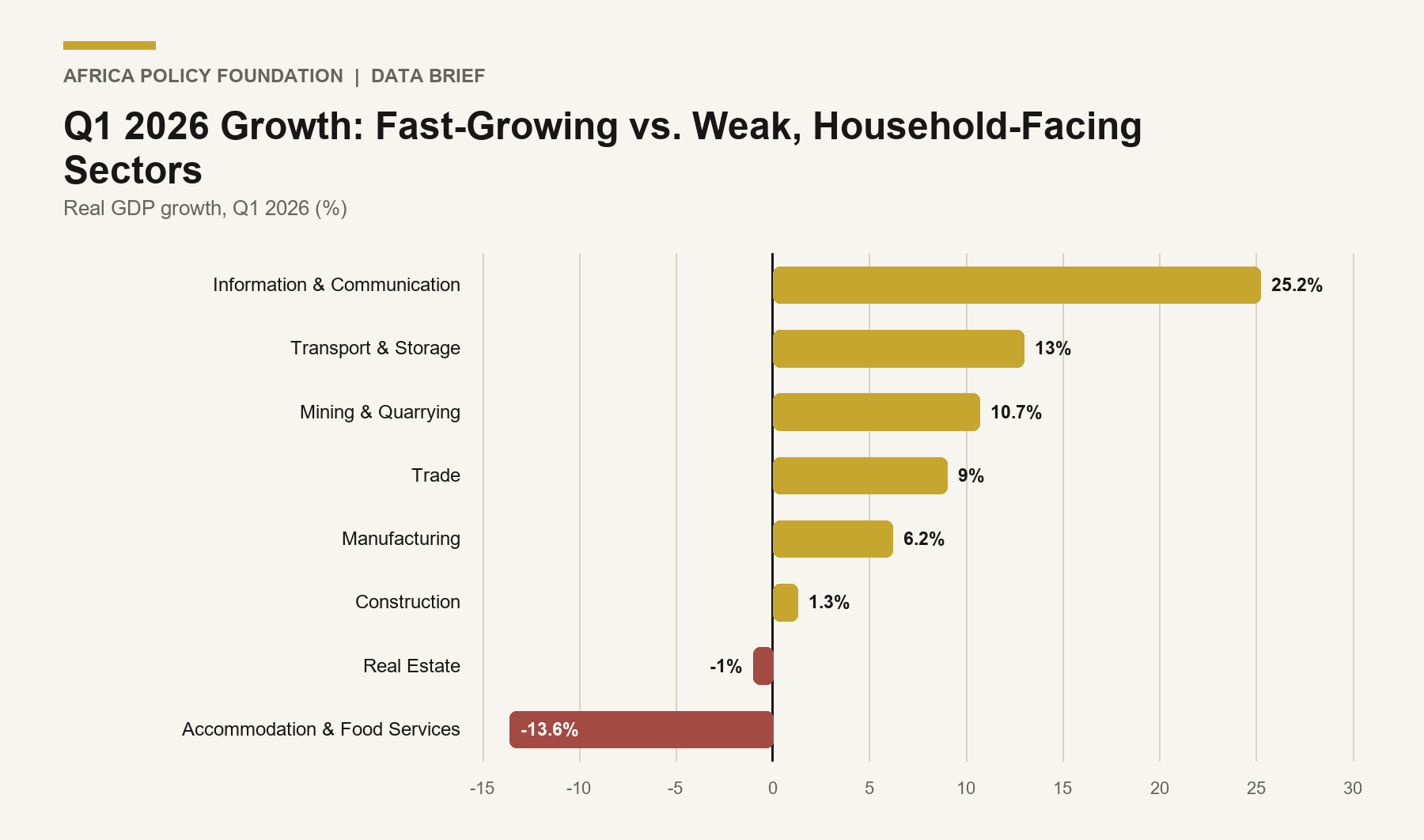
The composition of growth also offers positive signals. Information and communication grew by 25.2% in the first quarter, mining and quarrying by 10.7%, manufacturing by 6.2%, transport and storage by 13.0%, and trade by 9.0%. The oil and gas subsector returned to positive growth after a difficult 2025. This is broader than a recovery based on only one sector.
Inflation has fallen dramatically, from 23.8% in December 2024 to 5.4% in December 2025 and 5.3% in June 2026. The Bank of Ghana has reduced the monetary policy rate to 14%. The Ghana Reference Rate fell from 29.3% at the end of 2024 to about 10.0% by June 2026, while the average commercial lending rate declined from about 30.2% to 15.6%. Lower rates are reducing government’s domestic borrowing cost and should gradually improve financing conditions for private businesses.
The external sector is another source of strength. Ghana recorded a current-account surplus of US$5.1 billion and a trade surplus of US$8.8 billion in the first half of 2026. Gold exports generated US$12.5 billion, cocoa US$2.3 billion and oil US$1.7 billion, while private transfers reached US$3.6 billion. These inflows helped maintain gross international reserves at US$12.9 billion, equivalent to five months of import cover.
Fiscal performance has also improved. Total revenue and grants were close to target, while the primary balance and overall balance performed better than the half-year programme benchmarks. The review also reports that GH₵5.3 billion of existing arrears has been cleared—an important sign of improved expenditure control.
The IMF’s May 2026 assessment supports the broad direction of government’s account. Fund staff acknowledged substantial stabilisation gains while stressing that fiscal risks from state-owned enterprises, quasi-fiscal activities and contingent liabilities still require stronger safeguards, transparency and accountability. That balanced assessment is the right starting point: the progress is real, but it is not yet irreversible.
Growth Is Returning Faster Than Opportunity
Strong GDP growth should not be confused with an equally great improvement in household welfare. Five subsectors accounted for 86.6% of first-quarter growth: information and communication, mining and quarrying, trade, crops, and transport and storage. Several labour-intensive or household-facing subsectors were much weaker. Construction grew by only 1.3%, real estate contracted by 1.0%, and accommodation and food services contracted by 13.6%.
This concentration matters. A rapidly expanding telecommunications or mining sector can lift national output without employing enough people to transform the labour market. Mining can generate exports and tax revenue, but it is less labour-intensive than agriculture, manufacturing, construction and many service activities. The policy question is not only how fast the economy is growing, but how much employment, wage income and domestic value addition each percentage point of growth produces.
The review states that unemployment declined from 13.7% during the first three quarters of 2024 to 12.8% during the same period in 2025. That is progress, but an unemployment rate of 12.8% remains high, and the comparison does not provide a current labour-market reading for the first half of 2026. It also does not fully capture underemployment, informality or the quality of jobs being created.
The World Bank has described Ghana’s long-running challenge as a struggle to turn growth into jobs and opportunity. Its Ninth Ghana Economic Update argues that the country needs a comprehensive strategy on job creation, structural transformation and skills development. The 2026 review announces large projects and reports projected employment, but it does not provide a consolidated jobs account showing actual jobs created, their location, wage level, duration or skill content.
The reported rise in GDP per capita from US$2,527 in 2024 to US$3,385 in 2025 must also be interpreted carefully. A 33.9% increase in the US-dollar value of GDP per capita during a year when real output grew by 6.0% cannot be read as a 33.9% increase in the average Ghanaian’s real income. The figure is heavily influenced by nominal GDP and favourable exchange-rate conversion. That improves some international comparisons, but it is not the same as a sustainable one-year increase of one-third in per-capita income in cedi terms.
The review would have been more useful if it had connected macroeconomic growth to real wages, household consumption, business formation, employment, regional inequality and the cost of essential services. Those indicators would show whether the recovery is reaching people beyond the sectors driving the headline GDP number.
Inflation Has Fallen, but the Cost-of-Living Story Is Uneven
The fall in inflation is one of the clearest gains. It reduces uncertainty, protects working capital and allows interest rates to decline. Yet the June 2026 breakdown shows why households may experience the recovery differently from the headline rate.
Inflation for locally produced items was 6.7%, compared with only 2.3% for imported items. Services inflation stood at 9.4%, partly because of a rise in general service fees. Non-food inflation rose to 6.3% and accounted for about 69% of headline inflation. The data suggest that the remaining pressure is increasingly domestic and service-based, with partial attribution to the rise in fuel prices.
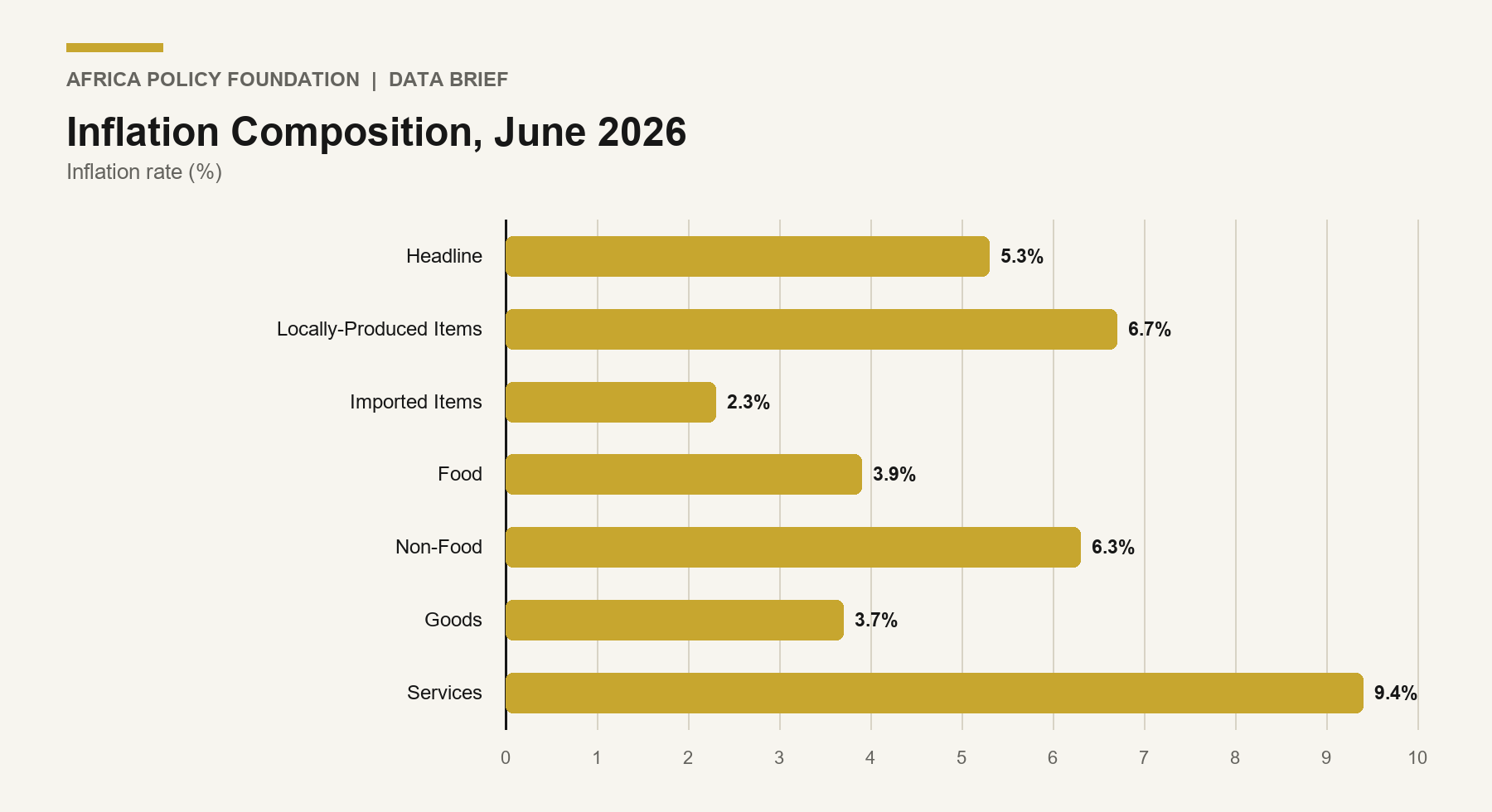
This distinction is important for policy. A strong cedi can reduce the price of imported fuel, machinery, pharmaceuticals and consumer goods. It cannot by itself solve high transport costs, weak domestic logistics, expensive electricity, housing constraints or inefficiencies in local food distribution. The next stage of disinflation will require productivity improvements and lower structural costs, not only exchange-rate stability.
The cedi itself also deserves a measured interpretation. It appreciated strongly in 2025 but depreciated by about 7.9% against the US dollar during the first half of 2026. That movement does not amount to a return to crisis. It does, however, show that the currency’s gains should not be treated as permanent: gold prices, export volumes, remittance flows, reserve-management costs and market confidence can all change.
The real success will be a cedi that is broadly stable because Ghana produces and exports more diversified goods, maintains disciplined fiscal and monetary policy, and attracts long-term capital. Stability that depends excessively on one commodity cycle will remain vulnerable.
Is the Fiscal Outperformance Efficiency or Under-Execution?
The key question is why the fiscal deficit was smaller than originally budgeted. Was this stronger performance driven by higher revenue, genuine expenditure efficiencies, or simply lower-than-planned execution of government spending?
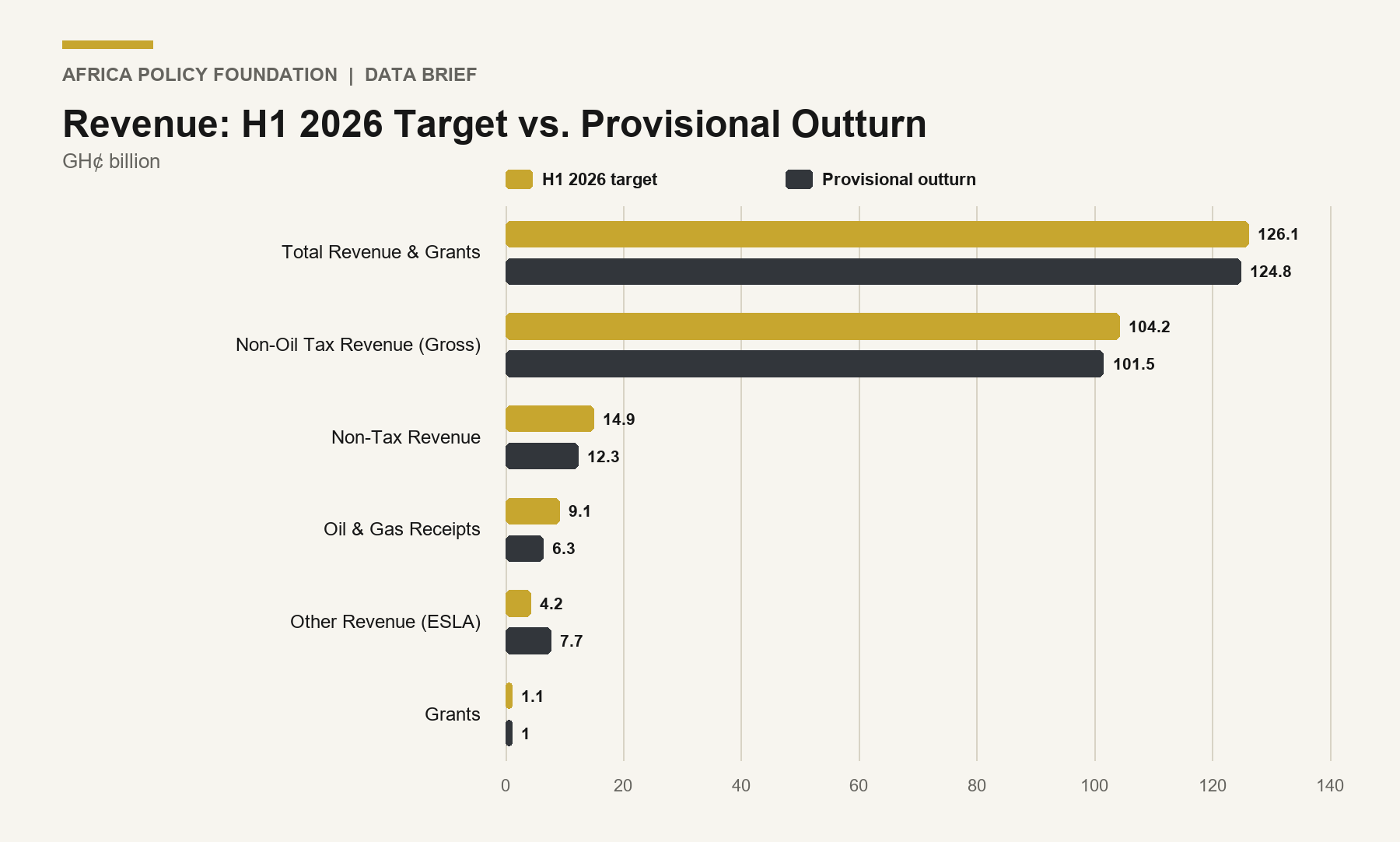
Total revenue and grants for the year to date amounted to GH₵124.8 billion against a target of GH₵126.1 billion—about 1% below target. Taxes on income and consumption exceeded target by GH₵4.3 billion. Energy Sector Levy proceeds were also well above the stated target. These gains offset weaker non-oil non-tax revenue.
The expenditure side tells a very different story. Total cash expenditure amounted to GH₵136.9 billion against a target of GH₵172.5 billion, a shortfall of GH₵35.6 billion, or about 20.6%. On a commitment basis, expenditure reached 8.0% of GDP against a half-year target of 9.9%, while primary expenditure reached 6.6% of GDP against a target of 8.1%.
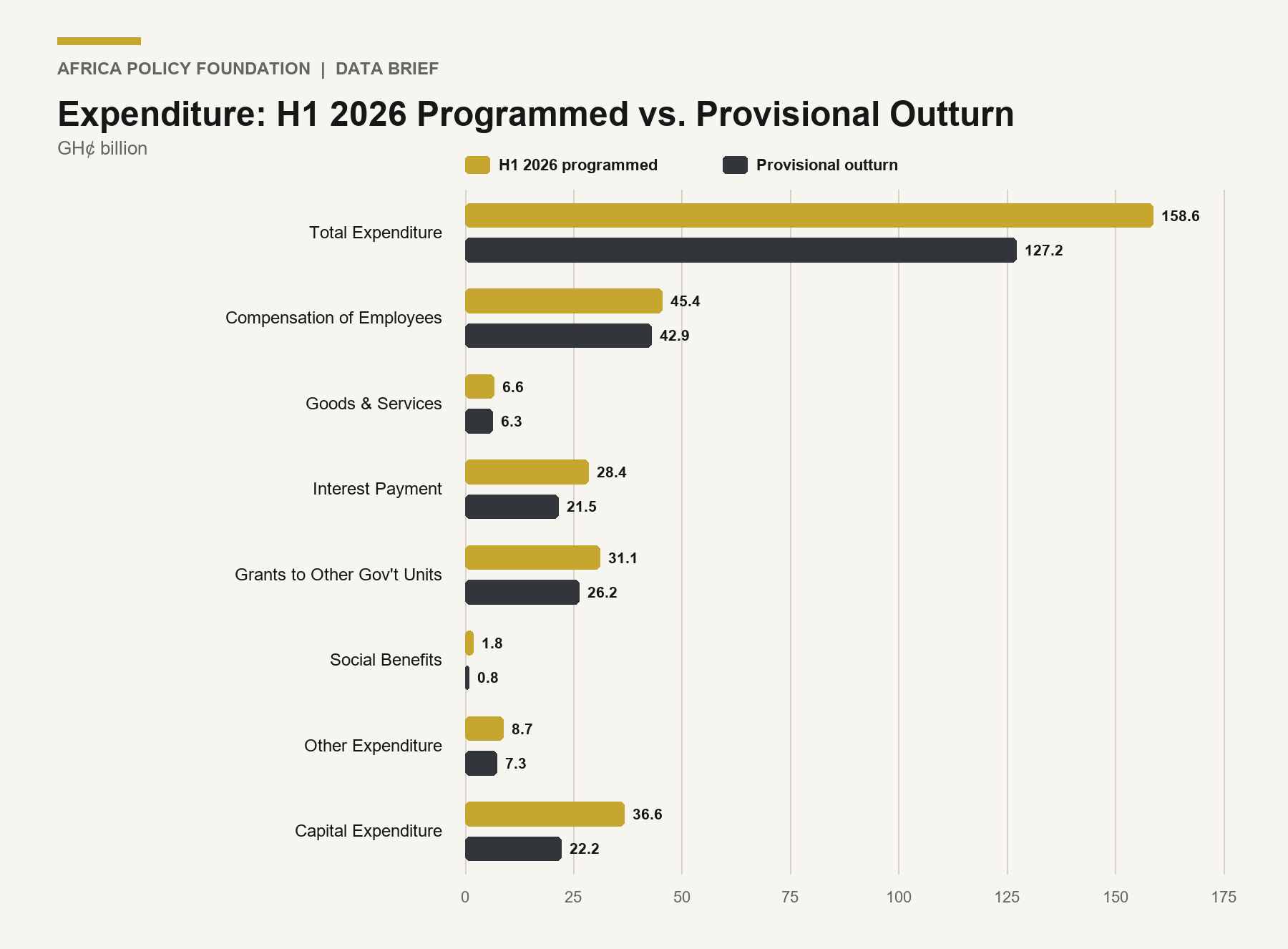
Part of this underspending reflects genuine fiscal improvements. Interest payments were GH₵6.9 billion below target as market interest rates declined and external debt-service costs remained lower than projected. Compensation of employees was GH₵2.4 billion below target, which government attributes to payroll controls and the removal of ghost names and unauthorised allowances. Expenditure on goods and services remained broadly in line with budget.
However, if part of the stronger half-year fiscal balance reflects planned expenditure that has merely been delayed because of procurement bottlenecks, slow project execution, financing problems or postponed transfers to public institutions, it should not automatically be interpreted as evidence of greater fiscal efficiency.
If the unspent amount reflects lower borrowing costs, the elimination of payroll leakages and the cancellation of non-essential expenditure, then fiscal quality has genuinely improved. If it reflects delayed road construction, unpaid suppliers, underfunded health services or postponed social transfers, the apparent fiscal gain may simply defer expenditure while weakening public service delivery and growth.
There is also a risk of second-half expenditure compression. When a large share of annual spending is pushed into the final months of the fiscal year, procurement quality can deteriorate, project monitoring becomes more difficult and pressure to accelerate commitments increases. Ghana has repeatedly experienced such fourth-quarter expenditure pressures.
The second-half fiscal outturn will therefore be critical in determining whether current outperformance reflects a durable improvement in expenditure efficiency or merely a temporary postponement of spending. Greater transparency on the composition of the expenditure shortfall would help distinguish genuine fiscal consolidation from delayed budget execution.
Reallocation and Reserve-Building Share the Same Blind Spot
Maintaining the overall appropriation without a supplementary budget is a sign of fiscal discipline, but internal reallocations still carry real opportunity costs that the review does not fully disclose. Government allocated GH₵5.0 billion to the Ghana Accelerated National Reserve Accumulation Programme (GANRAP), revised foreign-financed capital expenditure downward by GH₵3.0 billion following weaker-than-expected bilateral disbursements, and reallocated GH₵400 million for high-occupancy buses, GH₵350 million for flood response and GH₵226 million for additional flood-control measures. Each decision may be justified, but an unchanged envelope does not eliminate trade-offs.
GANRAP is the clearest example where greater transparency is needed. The programme aims to increase Ghana’s international reserves from approximately five months of import cover in June 2026 to fifteen months by 2028. Government reports that the programme’s average acquisition cost has fallen from 14.5% to 5.0% of the value of gold purchased, but the review does not explain what this cost includes, how purchases are financed, who bears gold-price and exchange-rate risks, how acquired gold is valued, or what financial return the reserve assets are expected to generate.
Government should publish, in a single schedule, every expenditure line before and after the mid-year realignment, identifying which programmes gained or lost funding and why. It should also publish quarterly GANRAP reports disclosing purchase volumes and prices, financing arrangements, logistics and refining costs, realised foreign-exchange proceeds, valuation changes, and any gains or losses borne by the budget, GoldBod or the Bank of Ghana.
The Debt Ratio Has Improved, but the Debt Stock Is Rising Again
The fall in public debt from 61.6% of GDP in 2024 to 44.7% in 2025 was a major improvement. Debt restructuring, strong cedi appreciation, fiscal consolidation and growth all contributed. The improvement in debt-distress assessments and sovereign ratings also lowers Ghana’s risk premium.
Yet the review’s own figures show why the 45% debt ratio should not be treated as a completed task. Total public debt increased from GH₵641.1 billion at the end of 2025 to GH₵719.5 billion by June 2026—an increase of GH₵78.4 billion, or about 12.2%, in six months. Domestic debt rose from GH₵333.8 billion to GH₵391.1 billion, while external debt increased in cedi terms from GH₵307.4 billion to GH₵328.4 billion. The debt-to-GDP ratio edged up from 44.7% to 45.0%.
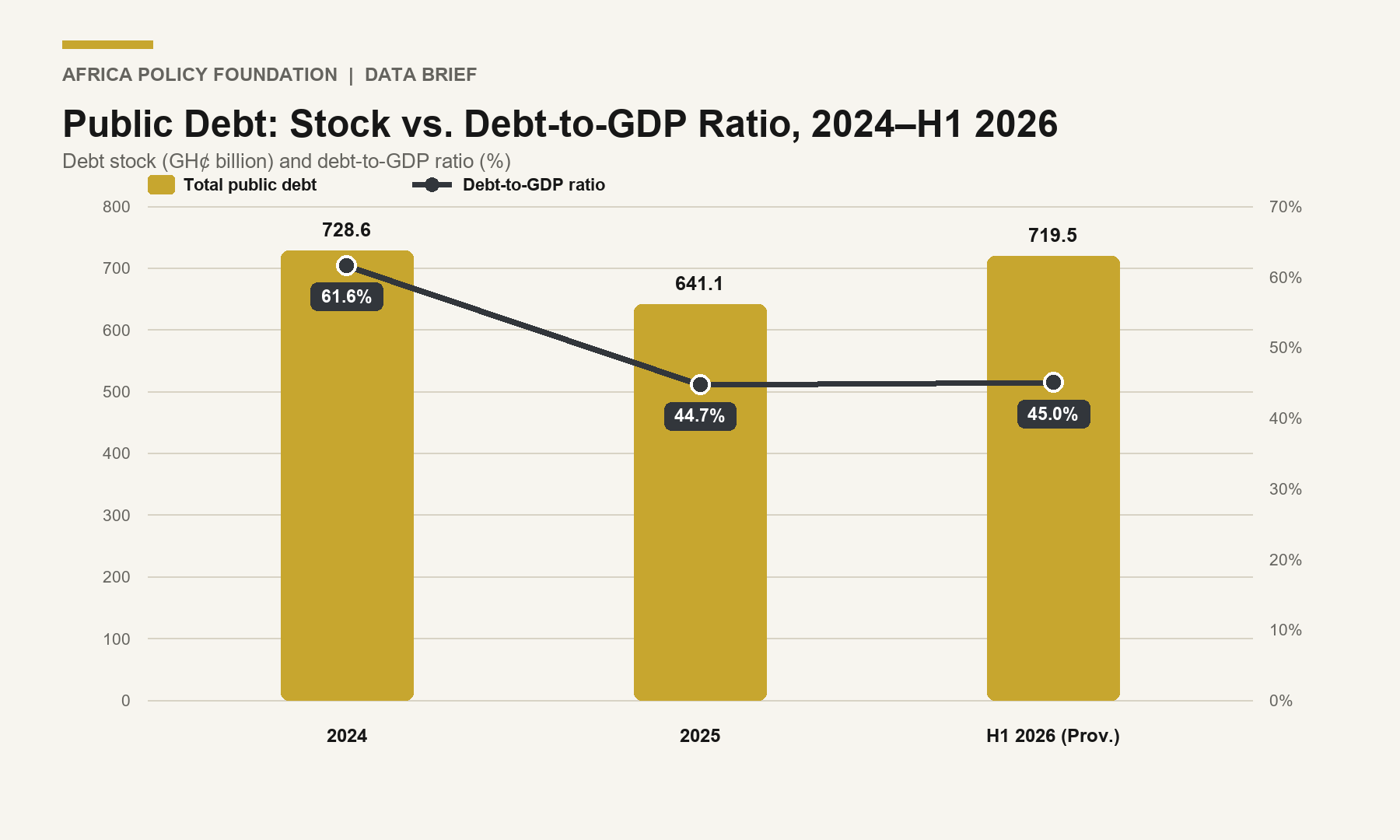
This does not mean the debt position is again unsustainable. It means the ratio is sensitive to the exchange rate, nominal GDP and new borrowing. A target achieved partly through favourable valuation effects can be reversed by a currency shock or weaker growth. Policymakers should manage both the ratio and the underlying debt stock, maturity profile, interest burden and currency composition more carefully.
The refinancing profile is especially important. The review reports GH₵58 billion of Domestic Debt Exchange Programme bonds maturing in 2027 and another GH₵53 billion in 2028. Government had accumulated GH₵15.6 billion in the Sinking Fund by 22 July 2026 and aims to reach GH₵30 billion by the end of 2026. Building the fund ahead of these maturities is prudent because it reduces refinancing risk and signals a commitment to meeting future obligations without last-minute financing pressures.
However, the GH₵111 billion of DDEP debt maturing over 2027 and 2028 remains a significant debt-management challenge. The review says the Sinking Fund will receive 7% of non-oil tax revenue and proceeds from domestic bond issuance. Borrowing to build a fund that will repay earlier borrowing can smooth maturities, but it does not by itself reduce the debt burden. The strategy’s effectiveness depends on borrowing costs, maturities, cash management and whether the fund is protected from unrelated spending.
Government should publish quarterly Sinking Fund statements showing inflows, investment returns, withdrawals, fees and the liabilities matched against the fund. It should also publish a detailed refinancing plan for 2027 and 2028. Credibility is strongest when the market can see not only that money has been set aside, but exactly how the repayment strategy works.
The Better Revenue Strategy Is Compliance, Not New Tax Handles
One of the strongest parts of the review is the shift from repeatedly raising tax rates to simplifying taxes, broadening the base and using technology to improve compliance.
The VAT reforms abolish the COVID-19 Health Recovery Levy, allow input deductions for the GETFund and National Health Insurance levies, reduce the effective VAT rate from 21.9% to 20%, and raise the registration threshold from GH₵200,000 to GH₵750,000. These changes can reduce cascading taxes, release working capital and remove small firms from a system that may cost more to administer than it collects.
Government also plans to collect VAT from non-resident digital platforms, roll out Fiscal Electronic Devices, introduce a VAT reward scheme and strengthen customs valuation. The cross-border digital VAT platform is projected to generate GH₵2.3 billion in its first full year. That is a forecast, not yet collected revenue, but it points toward a more appropriate tax base as activity becomes increasingly digital.
The Publican AI Trade Solution is presented as a major customs innovation. The review reports that approximately 366,000 declarations were analysed, 24% triggered more than one risk indicator, and assessed collections increased by over US$300 million between January and 17 July 2026. The system appears capable of identifying undervaluation, misclassification and questionable origin claims that are difficult to detect manually.
The opportunity is significant, but measurement should be precise. A valuation uplift, an additional assessment, a liability confirmed after appeal and cash actually received are different things. Public reporting should track each stage separately. Otherwise, projected or assessed revenue may be presented as money already available to the budget.
AI-supported customs enforcement also requires safeguards. Importers must know the basis of an adjustment, have access to a timely review and appeal process, and be protected from arbitrary or inconsistent decisions. Algorithms should support trained customs officers, not replace legal judgment. Independent testing should monitor false positives, bias, data quality and whether stronger controls increase clearance times for compliant businesses.
The proposed First Port Duty Rule could significantly reduce false transit declarations and revenue leakage. Its success will depend on effective customs-to-customs arrangements with destination countries. The reform should be supported by seamless data exchange, efficient clearance procedures and clear operational protocols so that revenue protection and trade facilitation reinforce, rather than undermine, one another.
Big Projects Must Move from Announcements to Auditable Results
The review contains an ambitious investment programme, with work said to have commenced on 87 Big Push projects. Government reports that 13 had reached at least 50% completion by June, including six above 75%. US$1.7 billion has been placed in a dedicated account for the Accra–Kumasi Expressway. Plans also include agricultural enclave roads, a 1,200-megawatt state-owned power plant, a modular gas-processing facility, an oil-palm finance facility, farmer service centres and a 24-hour economy programme.
These projects could address structural constraints that keep Ghanaian production expensive. Roads can connect farms to markets. Reliable gas can lower electricity-generation costs. Better urban transport can raise productivity. Agricultural mechanisation can reduce post-harvest losses and improve rural incomes.
The fiscal risks are equally important. Large state-led projects can create direct debt, guarantees, foreign-exchange exposure, land-compensation liabilities and future operating subsidies. A state-owned power plant can become a productive national asset, but only if demand forecasts, fuel supply, tariffs, procurement, financing and governance are sound. Ghana’s energy sector already carries large legacy debt.
The review states that state-owned enterprise liabilities have historically added heavily to public debt and identifies SOE and energy reform as priorities under the proposed post-IMF framework. Every major project should therefore publish a business case, financing structure, procurement method, value-for-money assessment, implementation milestones and contingent-liability exposure.
The same discipline should apply to the Accra–Kumasi Expressway account. Ring-fencing funds before the main contract is awarded may demonstrate commitment, but the public should know the legal custodian, currency composition, investment return, withdrawal rules and audit arrangements. Idle funds also have an opportunity cost.
The right measure of the Big Push is not the number of projects launched or the amount deposited. It is kilometres completed to standard, travel time reduced, maintenance funded, procurement savings achieved and economic activity unlocked.
The Real Post-IMF Test Is Institutional
The review places considerable emphasis on completing the Extended Credit Facility programme and moving to a non-financing Policy Coordination Instrument (PCI). That transition is important: a PCI can provide an external policy anchor and regular assessment without new IMF financing.
President Mahama framed this as a historic turning point, telling the 77th New Year School in January 2026 that it must be the seventeenth and last time Ghana goes for an IMF bailout. That is precisely the kind of pledge history should be allowed to test.
Ghana’s history shows that programme completion is not the same as reform completion. Fiscal discipline often weakens when external monitoring ends, elections approach or commodity conditions become less favourable. The lasting test is whether Ghana’s own institutions can enforce the rules when compliance becomes politically difficult.
The new fiscal rule, commitment-authorisation system, Fiscal Council, Value for Money Office, Sinking Fund framework and proposed SOE reforms are therefore more important than the ceremonial end of another IMF programme. Each institution must have timely data, operational independence, clear legal powers and a duty to publish its findings.
The review notes that one quantitative performance criterion was missed because the GH₵5.0 billion Bank of Ghana recapitalisation bond was recorded as a receivable from government rather than as recapitalisation. Government describes this as a technical accounting deviation rather than a policy breach. That may be correct, but it illustrates why classification, disclosure and institutional coordination matter. Fiscal credibility depends not only on intent, but also on accurate and consistent accounting.
One of those institutions faces an imminent market test. COCOBOD, still carrying roughly GH₵32 billion in debt, is among the state entities the PCI specifically targets for governance reform. It is preparing to raise close to US$1 billion in cedi-denominated domestic bonds ahead of the 2026/27 crop season to reduce reliance on foreign syndicated loans. Investor demand and pricing will be an early market vote on the credibility of the reforms.
The IMF’s proposed PCI should support Ghana’s domestic institutions rather than become a substitute for them. The goal should be a country that maintains discipline because its laws, Parliament, markets and citizens demand it—not only because an external review is approaching.
Policy priorities
What Ghana Must Do Next
Publish the Full Expenditure Reconciliation
Explain the GH₵35.6 billion gap between targeted and actual cash expenditure, distinguishing permanent savings, delayed spending, cancelled programmes, unpaid commitments and amounts expected to be executed in the second half.
Protect the Debt Gains
Publish a quarterly refinancing plan covering the GH₵111 billion of DDEP maturities due in 2027 and 2028. Independently report Sinking Fund inflows, investment returns, withdrawals and matched liabilities.
Make GANRAP Fully Auditable
Assess reserve accumulation on its net economic benefit, not only the quantity of reserves acquired. Disclose programme costs, gold purchases, valuation changes, financing arrangements and fiscal or central-bank losses regularly.
Measure Revenue Technology by Cash Collected
Report declarations reviewed, assessments issued, appeals completed and cash collected as separate indicators. Independent audits and taxpayer appeal protections should form part of the system.
Apply Fiscal Discipline to Flagship Projects
Give every major project a published business case, financing plan, procurement record, implementation schedule and contingent-liability statement. Audit ring-fenced project accounts and disclose their returns.
Add a Jobs and Living-Standards Account
Future budget reviews should report actual jobs created, formal-sector employment, real wage growth, regional job distribution, youth unemployment, business credit, household consumption and the cost of essential services.
The Verdict
Ghana’s 2026 Mid-Year Fiscal Policy Review presents the strongest macroeconomic scorecard the country has seen in years. Growth is robust, inflation is low, reserves are stronger, fiscal balances have improved, and debt risks have eased. Government also deserves credit for maintaining the approved appropriation, reducing interest costs, clearing arrears and pursuing tax compliance instead of introducing another collection of new tax handles.
The central question has now changed. The issue is no longer simply whether Ghana can stabilise after the crisis. It is whether the country can use that stability to finance productive transformation without rebuilding the fiscal risks that caused the crisis. The answer will depend on the quality of public investment, the transparency of GANRAP, management of the 2027–2028 debt maturities, the financial discipline of state-owned enterprises, and whether technology-based tax enforcement respects accuracy and due process. Above all, it will depend on whether growth produces enough productive jobs and measurable improvements in household welfare.
Stability is back, which is worth recognising. But prosperity cannot be declared from a podium or inferred from a stronger currency alone. It must be visible in the productivity of Ghanaian firms, the incomes of workers, opportunities available to young people and the quality of services citizens receive. The review shows that Ghana has created a stronger foundation. The next budget must show what the country is building on it.